
The collections of science teachers
By Margo Smith
When you become a science teacher, you quickly get used to finding some pretty random objects in your classroom and storage areas — left behind by those who taught before you.
When I was student teaching in a neighboring district, I opened my desk drawer on my first day to find a mummified green frog hanging out next to a collection of pens. It turned out that a student had given that frog to my cooperating teacher — and yes, this happens more often than you might think. While some may find that a bit gross, many of us in the science world have come to accept that it simply comes with the territory.
It’s not always animals (stuffed or mummified), bone collections, or even beehives that we inherit. I’ve also come across heavy spools of wire, towers of ice cream buckets, and plenty of items that make you ask, “What do you think this is?” Because we learn to stretch our budgets, we often add to these collections by asking colleagues to bring in materials from home — cardboard boxes for marble roller coasters, two-liter bottles for water bottle rockets, or even broken Christmas lights for wiring circuits. And my colleagues always deliver.
One of my favorite discoveries, however, was a bike stored in our science cage above the band room. This bike had a motor attached to a rear rack and was clearly wired to be connected to something — but what, I didn’t yet know. That’s when I reached out to well-known and well-loved retired science teacher Carol Welling for help. Carol graciously came in to show me the pieces that connected to the bike and how to hook it up so students could turn mechanical energy (pedaling) into electrical energy — powering light bulbs, hair dryers, and more — and discover just how much effort it takes to do so.
The bike quickly became a source of both fun and learning for our sixth graders during the Renew Our Schools competition last fall. Students were challenged to pedal for six minutes while lighting two 50-watt incandescent bulbs. Judging by the looks on their faces, it was no easy task. Their six minutes of effort produced about one-tenth of a kilowatt-hour — roughly a penny’s worth of electricity. Many of the seventh graders who saw the bike in my classroom couldn’t resist trying the challenge themselves.
After the competition ended, the bike remained in my classroom as an alternative seating option. But for a group of seventh graders, it sparked a much bigger idea.
CyclePaths give the energy cycle a second life. For two years in a row, a group of Amherst Middle School students has applied for and been awarded a mini-grant from Wisconsin’s K-12 Energy Education Program (KEEP) at UW-Stevens Point. This year, Nathan Bannach, Nathan Wachowiak, Blake Glodowski, Lorelei Pillsbury, and William Smith proposed transforming the classroom bicycle into a Chromebook charging station while maintaining its original function as the Energy Cycle used during the Renew Our Schools competition.
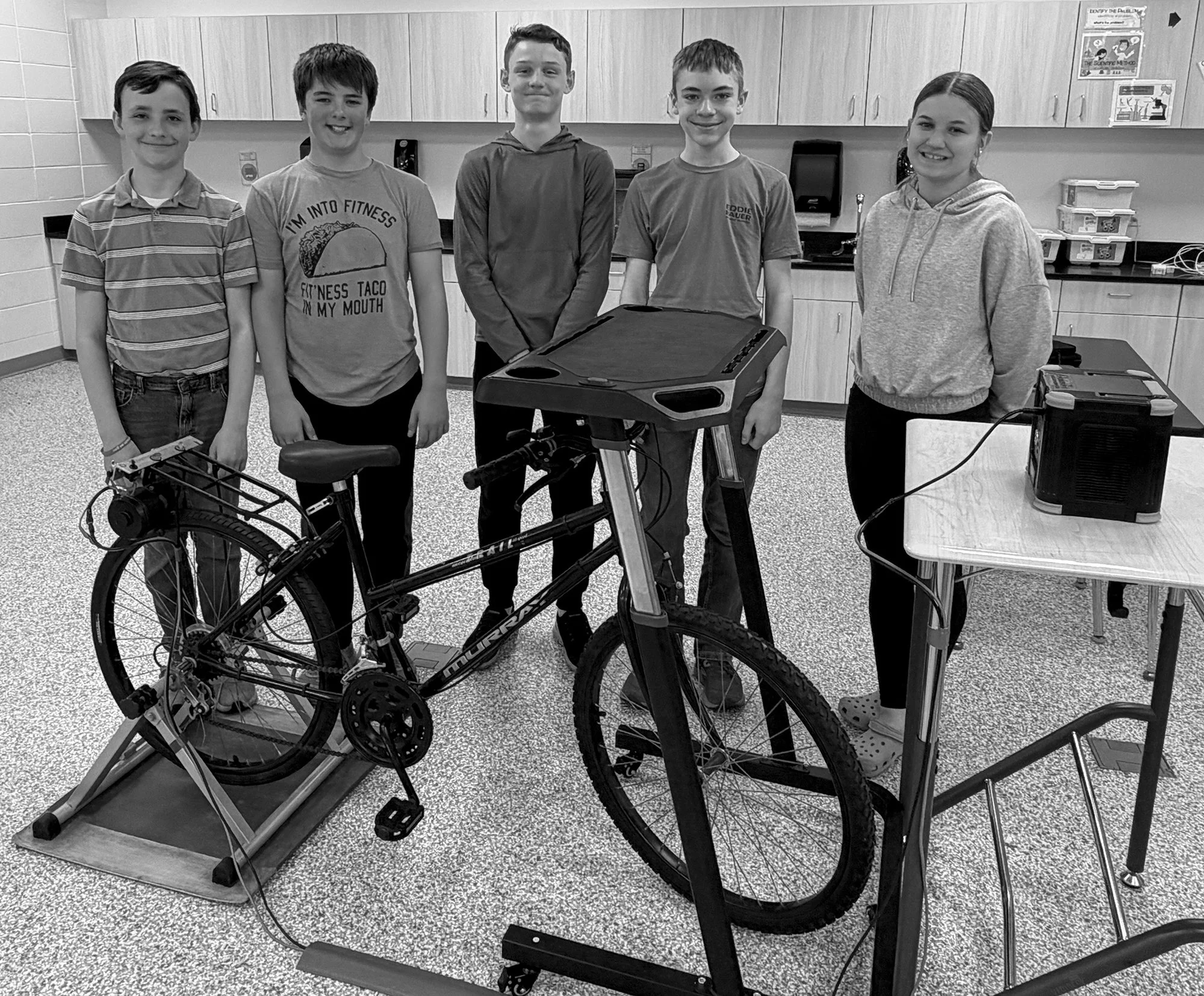
The CyclePaths (left to right): Nathan Bannach, Will Smith, Nate Wachowiak, Blake Glodowski, and Lorelei Pillsbury.
The self-named “CyclePaths” called their proposal the “Ride-Back a Bluesheet Bike,” a nod to the idea that students could avoid getting a disciplinary “Bluesheet” by charging their Chromebook using their own energy instead of the school’s electricity. It was a fun idea — but one that required serious research.
The group quickly discovered that the direct current (DC) generated by the bike’s motor could damage Chromebooks if used directly. They explored solutions, including using a controller to regulate current or storing the energy in a battery before converting it to alternating current (AC) for safe use. Along the way, they determined the appropriate wire gauge, figured out how to connect components, selected the necessary plugs, and created a detailed budget using a Google Sheet.
When they received news that their grant had been approved, the real work began. The students assembled an upright cycling desk, learned how to splice and connect wiring, had virtual meetings with the grantor, and used a computer design program to create a 3-D-printed mount for the power cell. After several iterations, they landed on a design that worked.
To complete the project, the team created a data table — now displayed on the desk — showing how long students needed to pedal to gain a certain percentage of charge. One surprising discovery? It takes more than an hour of steady pedaling to fully charge a Chromebook.
Each team member played an important role in the project’s success. Blake became the group’s “electrical expert,” Nate B and Nate W (known as “Nate²”) kept energy high with playlists and humor, Lorelei brought strong writing and organization skills, and Will proposed the idea, formed the team, and kept spirits up along the way.
I am incredibly proud of this group of students who saw a bike, had an idea, and turned it into something meaningful for their school community. Through this project, they demonstrated creativity, perseverance, and leadership while developing valuable problem-solving and executive functioning skills.