
Lady Lovin’ Her Life: Are you working too hard in your garden?
By Paula O’Kray
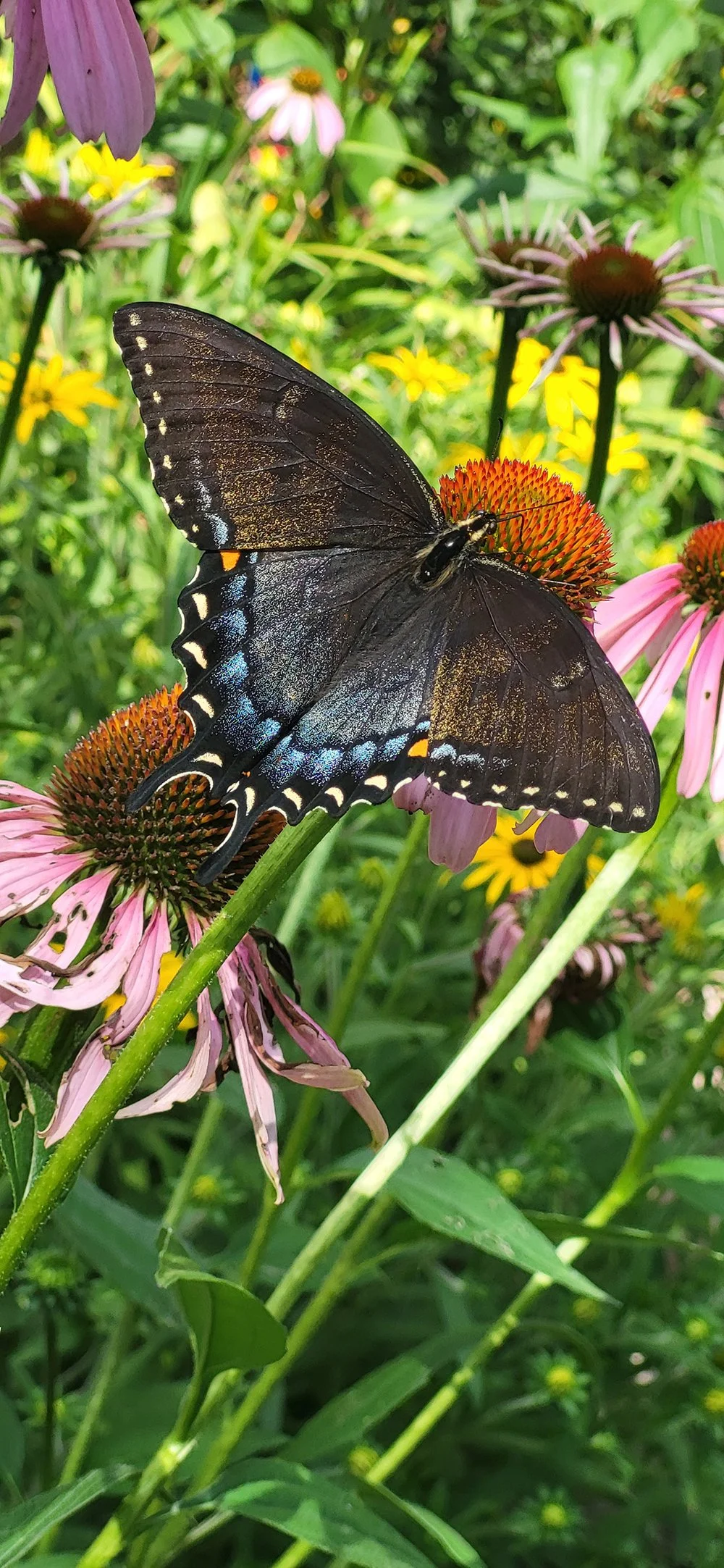
A beautiful Eastern Black Swallowtail that visited my garden last summer.
A long time ago, in a galaxy far, far away, I was married and had a family. I had a big yard and knew that I wouldn’t have time to do a lot of gardening, so I had to be strategic.
I bought a book on low-maintenance gardening. Read it from cover to cover, taking in all the hints and tips of having a beautiful garden with little or no maintenance.
You’d think the first step would be to buy no-fuss plants that will grow anywhere. You’d be wrong.
Plants that grow anywhere are typically non-natives and invasive, and once they take hold, it’s difficult to get rid of them.
You might think buying your favorite plants would be a good place to start. Wrong again.
Some plants, although beautiful, need a lot of attention to grow well. Plants not only need specific light to do well, but also the right soil, and many times additional pruning and fertilizer to do their best. That’s a lot of work.
I once had a seasoned gardener give me some of the best advice. “Figure out what grows best in your garden, and only grow that. People will think you’re a genius.”
Very good advice! But there’s more to it than that.
In the mid-’90s, I became a Master Gardener. At that time, it was a 12-week program that focused on a different topic each week. At the end of the 12 weeks, you took a take-home, open-book test. You couldn’t fail.
You became a steward of good gardening practices and had to put in a certain number of volunteer and education hours every year to keep your status current.
I figured it was a good way to learn how to maintain the grounds around my home without having to hire and pay a landscaper. I was right.
Not only did I learn a lot from the classes and other gardeners, but I also got to take a lot of bus trips to fun places and share the excess the other members had from their gardens.
Gardeners are some of the friendliest and most generous people you will ever meet. Over the years, I made some wonderful friends and gave a lot of advice to neighbors and co-workers when it came to making the most of their green space.
So the actual place to begin is with the soil, as all soil is not created equal. Also, how you amend soil is dependent on what you plan to grow in it.
The UW-Extension office will tell you how to take a soil sample from the area you are planning to garden in. You simply have to tell them what you plan to grow there, and they will tell you what you need to do to grow those plants successfully.
Next, you need to consider your gardening zone. Not all plants grow all places, and if you don’t want your perennial (comes up every year) to become an annual (grows only for a season), you’ll have to do a bit of homework.
Now let’s look at your yard. Do you have areas of full sun, full shade, or something in-between? The sun moves throughout the day, and some plants like morning sun, some like the hot afternoon sun, and some like speckled shade.
Is your yard dry, wet, or a combination? Choosing plants that need a lot of moisture when your yard is hot and dry is going to make you miserable trying to keep them happy.
Instead of choosing a plant and hoping it will grow, it makes more sense to choose from plants that like the conditions you have naturally. This way you won’t have to babysit them. You already know they are happy and so you’ll have a lot less work to help them thrive.
Of course, we all have our favorites and try to grow them anyway. That’s just a natural thing. You see something beautiful and you want it in your garden. That’s okay! If the rest of your yard has plants that naturally love the environment, you can use your time to focus on the few that are fussy.
Sometimes plants will surprise you and grow well in spite of your environment, so it’s always worth a try. Start with one or two plants. If after a season or two they are popping up and doing well, get more. If they fade away, don’t waste your money on more.
If you’re not sure about a plant, ask the nursery staff for more details on where it grows best. You can always Google it as well. In fact, you can take a photo of a plant you like, upload it to Google, and ask any question you like about it and get a pretty good answer.
For the ultimate in low- or no-maintenance though, you want to work with native plants. Natives are beautiful in their own way, and thrive all on their own with no attention, because that’s why they’re natives. They thrive on their own in the wild, giving life, health, and habitat to bees, birds, and wildlife.
Native plants support biodiversity, and will survive dry periods more easily than non-natives, since their roots go into the soil for several feet. That means less watering for you. Let Mother Nature handle it!
Native plants also help improve soil health, reduce erosion, and the need for chemical fertilizers and pesticides, which are bad for everybody. Native plants naturally resist pests and disease without these poisons.
Native plants can improve rainwater absorption, reducing runoff and help manage stormwater effectively. These plants are also a vital food source for bees and butterflies, and who doesn’t want that?
Also, native plants offer a wide variety of colors, forms, and textures, which is what makes a garden most interesting and beautiful. Perfection has a tendency to be boring.
Besides, a bit of wild acts as a natural pest control system, attracting beneficial insects that prey on the problem ones.
When I moved to this area, I was thrilled to discover Generation Native Plant Nursery, a local business run by Nichole Good, a lovely lady who really knows her stuff.
I dropped in one day, introduced myself, and began a lovely friendship that grows stronger every year. Over the years, Nichole has helped me “rewild” my backyard and made excellent suggestions that I would never have considered.
The best part is that these plants don’t fail. They are the tough guys of the plant world, the survivors. And with Nichole’s expertise on where and when to plant, you simply can’t screw this up. Believe me, I am really good at that.
If you’d like to learn more about the Master Gardener Volunteer Program, call the Portage County UW-Extension at (715) 346-1316 or find them online. If you’re interested in learning more about native plants, check out Wild Ones at wildones.org. If you’re looking for good advice and a wide variety of beautiful and healthy native plants at great prices, visit Generation Native Plant Nursery at 363 County Road KK, Amherst.
You can tell Nichole I sent you.
And whatever you choose to grow, I hope your garden is brimming with happiness this season!