
I’d Rather Be Wright, II: Comparative gardening and storytelling. Men of the soil
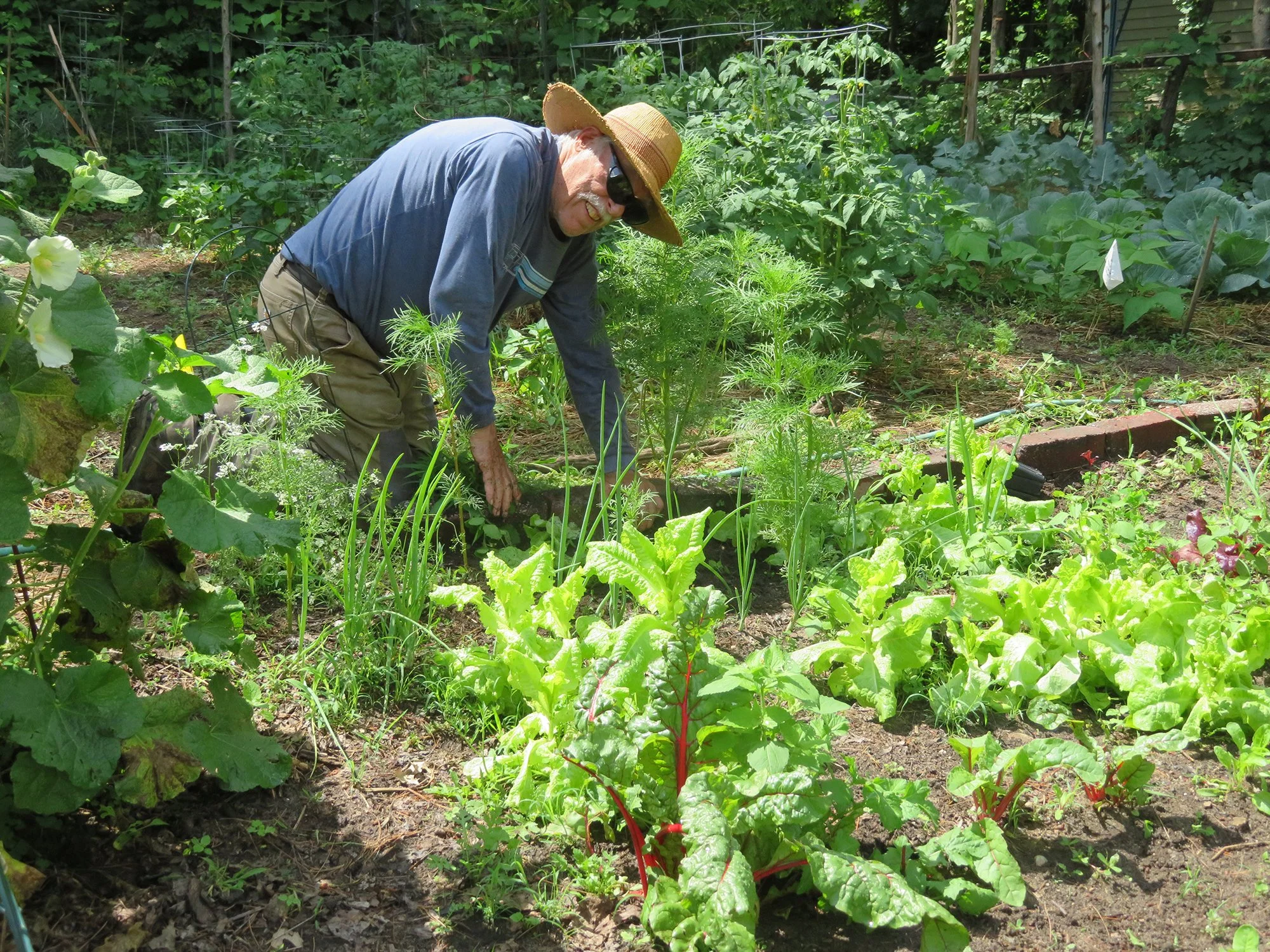
A man of the soil toiling in his little patch of earth.
By David Wright
The garden is winding down as it does every year at this time. As usual, there have been dramas including my hand-to-hand battle with wabbits (youthful dialect). This year they loved my beets to death. They also took a hankering for the traditional meal of Bugs Bunny, the carrot. We talked numerous times, but ultimately I had to officiate a couple of Christian burials.
While my stories of being a backyard farmer are extensive, some colorful, others are a saga of disappointments almost leading to starvation for lack of rutabagas. Right here in town, this bastion of civility and pastoral tranquility, we have had deer problems and even had a bear pass through on a rampage and general communal alarm.
However, in recently reading my father’s columns in the Marquette County Tribune, I realized he, too, had gardening issues. So there in his “I’d Rather be Wright” offering, he pontificated not unlike myself. Here is a brief extraction from his column — keep in mind this was at least 45 years ago; nothing changes.
R.T. Wright wrote in a column called “Man of the Soil, That’s Me”:
About the time the tender green things were first struggling to escape from the rich, warm earth, I became aware of a herd of monstrous rabbits which lurked in the bushes to emerge after dark to sate their ravenous appetite on my handy work. I solved this problem with a .22 rifle and it turned out later the rabbits were the only edible product of my plot of earth. This was only fair as the rabbits, to my knowledge, were the only living things that made a meal out of the product of my rich, warm earth.
Some, like the beets and carrots, never summoned the energy even to germinate (though I may have simply forgotten to plant them). Some, like the lettuce and onions, were hoed out accidentally under the impression they were weeds. Still others, like the broccoli, looked successful but turned out to be inhabited by tender, green things that crawled.
But through it all, there was a bright spot — the potatoes. Carefully, I cultivated them and sprayed them and fertilized them, picked off horrid bugs from their leaves and otherwise treated them with courtesy and love. Sometimes I would even go out and urge them on in the manner of a high school cheerleader. They responded by growing and growing. The one ray of light in my garden of despair.
But fate had other plans. One bright morning I strode happily to my microcosmic farm, pausing to feel the rich, warm soil and watch the tender green things (or what remained of them) — I even listened for a lark. I was a man of the soil. It was my life. I was full of inspiration. I could have recited poetry, easy!
But there, instead of lush rows of huge potato plants, there were only gaunt, sterile pits, like shell holes! I was crushed. I was beaten! I felt bad!
What catastrophe had descended upon my work-worn back? My sons, fired up by lectures on free enterprise, had dug up my potatoes and sold them to the neighbors for five cents a bushel!
So what goes around comes around it would seem. Now some might say that not only are these two, father and son, like each other in that they have been writing all of their lives, but they blab out the same stories.
Yes, there are similarities. Both of us were, and in my case are, country bumpkins who reveled and revel in the life close to the soil. Mind you, he was born in New York and raised in Chicago, so his soily hands came later in Montello. Mine is more life long and more rooted if you will. Most importantly, I always tell the truth. He, unlike me, was a genuinely lousy gardener, and more significantly, I never sold off his damn potatoes!